A door of hope in the valley of Achor – from Hosea 2:15
My mother is frequently telling me that it’s amazing what we have stored away in our heads. This is partly because she’s almost 90 and has forgotten that she made the same observation ten minutes earlier. The context of her comment tends to be the sort of trivia which will provide answers to the obscure clues given for The Telegraph weekend crossword but, more specifically, she’s referring to music.
She’s not wrong. Whenever I stay with her, we find ourselves in the kitchen humming along to all manner of tunes which seem to be on perpetual loop from Classic fm. This plays in the background for most of the day (with the exception of Alexander Armstrong. She’s not a fan: ‘Talks too fast. Drops the ends of his sentences. Wretched man; can’t understand what he’s on about…’ etc).
It seems it’s not only riffs from the classical collection that are dredged up from deep in the sub-conscious. Only yesterday I was cooking porridge and out of my mouth came the triumphant musical phrase: All together in the floral dance! Good heavens; where did that come from? The spirit of Terry Wogan must have been rustling in the leaves, brought in on the storms or something.
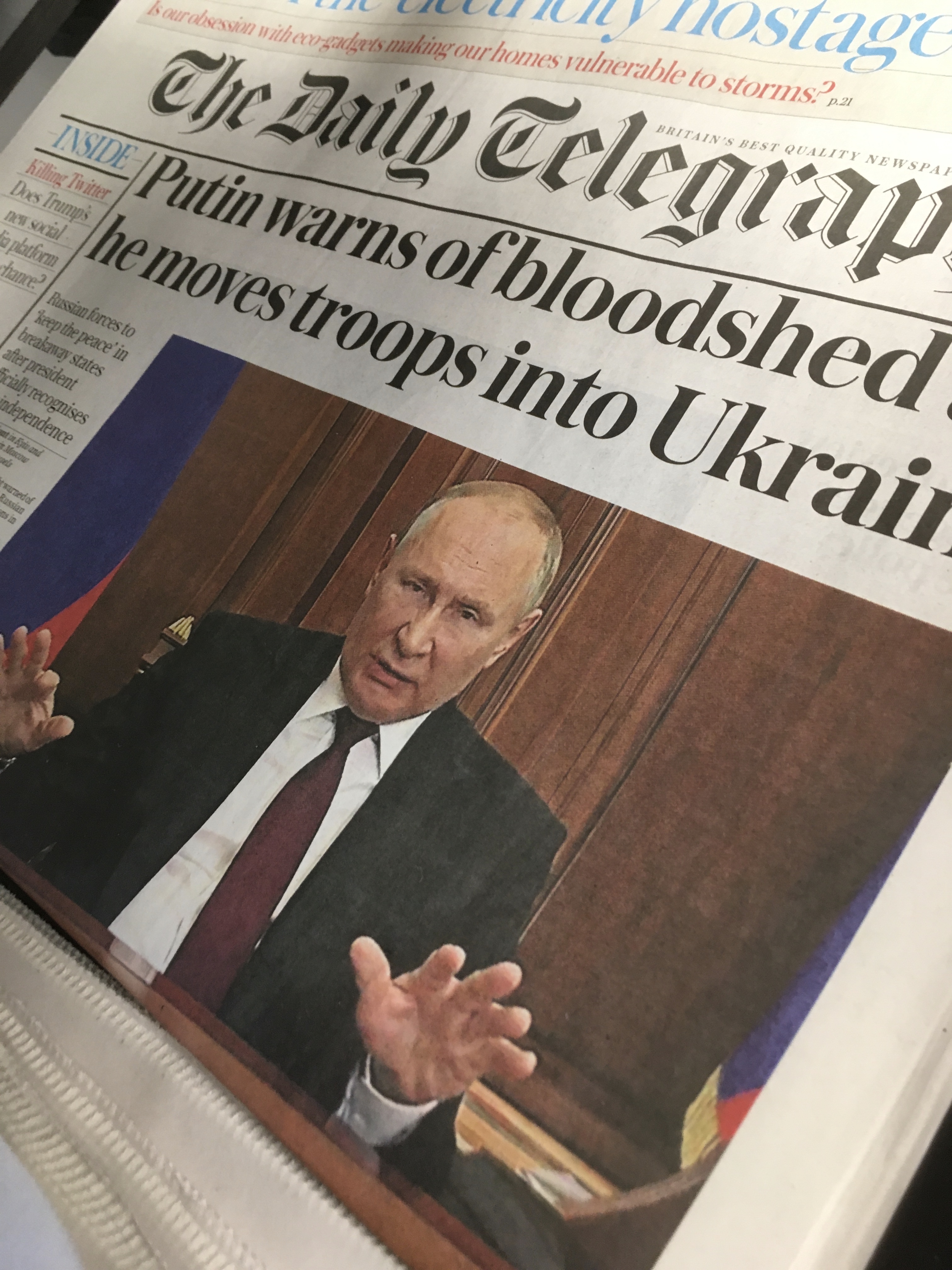
This all seems rather trivial in the light of the newspaper headlines today, but I have also recently found myself singing, It’s a long way to Tipperary and, The white cliffs of Dover. As someone born a considerable time after these popular songs were being churned out in hostelries and air raid shelters, these would not be the tunes of my youth. It made me wonder which songs will be sung in the days ahead, whether in Ukraine, Russia or the west in general. I can only think they will be laments in a minor key.
Just a few days ago, I read that 100,000 troops were lined up on the Ukrainian border. Yesterday the number reported was 190,000. I can’t help thinking that our own government must be regretting their massive underfunding of our own armed forces at this moment, and with who knows how many billions spent during Covid there’s not a lot of cash sloshing around right now.
Last Sunday was a day of prayer and fasting for many churches in the Ukraine; a day to cry out to God for mercy for their nation and for courage for whatever they may be required to face in these dark days. And I wondered, again, what would it take to get our nation on its knees?
As far as I’m aware that hasn’t happened sine King George VI announced in May 1940 that the following Sunday would a national day of prayer. Apparently, as an urgent request went out for small boats and dinghies to help with the rescue of a third of million troops, there were queues outside cathedrals as the general public humbled themselves and went to do business with God. [ https://canonjjohn.com/2017/07/17/national-day-of-prayer-during-dunkirk-1940/ ]
That ten day evacuation became known as The Miracle of Dunkirk, and Churchill, among others, used the word advisedly. There are tens of thousands of people today who still believe that prayer can change things. Perhaps it will change the weather, a set of events, or the hearts and minds of world leaders. Perhaps it also serves to remind us of our fallibility, our relative insignificance in the entirety of the universe and brings to mind the comforting words of Biblical truth which have sustained both soldiers and civilians through many conflicts.
During World War I the armed forces were issued with Bibles small enough to fit in their breast pockets. Stories are told of how these literally saved the lives of some men as bullets lodged in the pages, and of how the dying found comfort and salvation in their dying moments within those same pages. [biblesociety.org.uk/latest/news/bbc-report-highlights-importance-of-bible-to-ww1-soldiers/]

As I took the opportunity to take a walk this week between the pounding of storms Dudley, Eunice, and Franklin, I came across a small clump of mini-daffodils. Their cheerful sunshine heads, blowing energetically seemed to trumpet hope. Hope that the spring may finally come; hope that colour will return to our winter world and the hope that nature brings with her regular rhythm of seasons which come and go.
Putin may sit at his giant desk like a modern tsar decreeing his decisions with all the theatricality he can muster, but no one lives for ever. I wonder whether some superstition prompted him to mobilise his troops and tanks on 2.2.22. it doesn’t matter, I’m sure there are people praying in Russia today, just as there are in Afghanistan, North Korea, Somalia, Yemen, Eritrea, Iran and all the other places where conflict and dictators have become part of life.
When it seems there are no songs left to sing, I found myself singing one which we have included in our Steadfast road-shows this season. Our theme has been taken from a verse in the tiny book of Hosea which talks about a door of hope in the Valley of Trouble (Hosea 2:15). Ladies and gentlemen, welcome to that valley. The song is called Hope has a Name and you can find it here: https://www.youtube.com/watch?v=jTYsapLrOto
It’s stuck in my brain along with all those other tunes; but this one is going to regularly be rising to the top. I think I’ll be singing it, or praying it, for some time.


A hope whose name is Jesus. Amen
Thanks Jen
M x
>
LikeLike