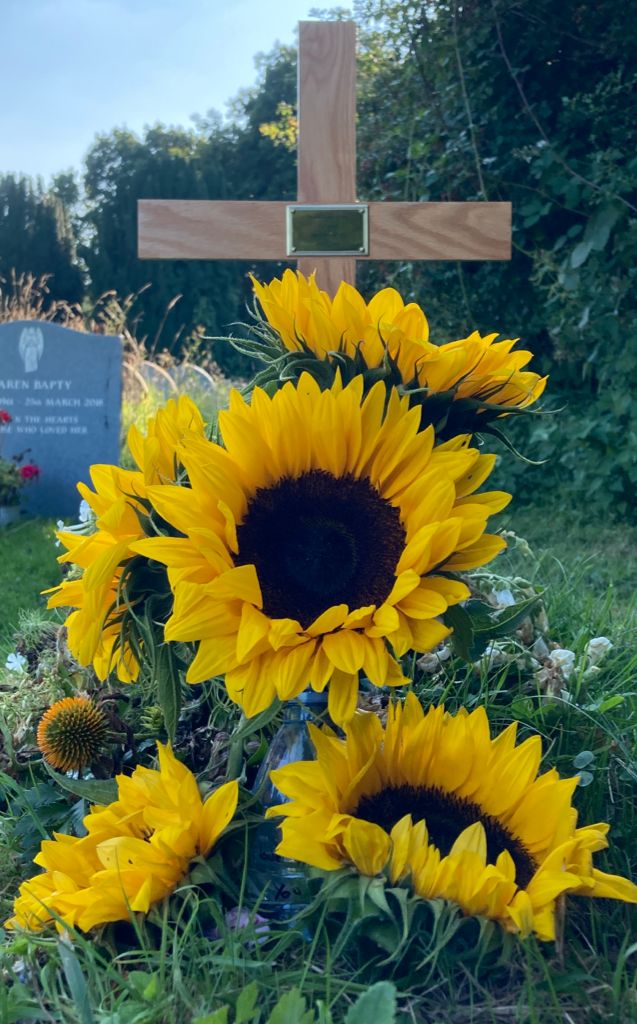
“No parent should have to bury a child” – King Theoden; Lord of the Rings
There is something very chilling about the phrase, ‘life limiting condition’. Setting the parameters of a life, even though it’s barely begun, seems heavy-handed. In a world of toxic positivity where everything is ‘supposed’ to be upbeat, air-brushed, photo-shopped and joy-filled – even if it is curated to fit that flimsy Facebook philosophy for a fleeting moment – the harsh realities of the real world impinge on that relentless and unfounded optimism with all the clinical deftness of the surgeon’s scalpel and the finality of the judge’s hammer.
A young boy I know (who I will refer to simply as ‘H’), saw only three summers. Unlike his healthy twin, he was born with complex medical conditions. His little body spent most of his days struggling to work adequately. He missed all of his typical child development targets, that are set out by professionals, but my goodness, he was loved.
Like all of us, H began life as a consumer intent on having his needs met. For obvious reasons, that was a continual challenge for both him, his parents and his carer. I know that because my wonderful, compassionate daughter was his carer.
While most people only saw a sick, helpless boy, she saw a child who was loved unconditionally and who gave back in shed loads. H had no time to gain academic honours or degrees; no ambitions to break world records or explore far flung places. What he grasped in his brief lifetime however, was the wonder of being loved and a chuckle that compelled a smile.
When he smiled, his whole body smiled too. He was a ‘wriggle pants’ who never mastered locomotion but enjoyed sitting in his specialised seating or lying on a mat from which vantage point he devoured animated cartoons or whatever show his brothers were putting on with their games. He learnt the intricacies of cause-and-effect and could press a button to make a buzzer sound or make his toys move and/or sing, both of which elicited unrestrained giggles. More recently, he spent time at a remarkable special needs school where he was able to access equipment so that he could be vertical for periods of time. In this position he loved to dance to his favourite song, Moment of Truth from the film Smallfoot.
I watched his face light up when he heard my daughter’s voice and when she cradled him in her arms. I saw her come alive as she painstakingly cared for his most basic needs, gently, confidently, respectfully and fondly.
It wasn’t the first time he’d been blue-lighted to hospital. On a number of occasions his breathing became difficult and additional oxygen support was needed; antibiotics were also often given by IV, as they were again this time. We all thought the worst was over once they’d been administered and he’d be home by teatime. It was not to be. His weakened body fought like a trooper but it was one round too many in the ring for this little fighter.
I cannot begin to imagine what it must be like to say “Goodbye” to your child so permanently and prematurely, from the confusion of hospital tubes and machines with the prevailing smells of antiseptic hanging in the air and the bustling sounds of staff bustling in impersonal corridors. No parent should have to bury their child. It goes against every law of nature we understand, despite our cognitive grasp of statistics about infant mortality – something that our brains tell us happens in far away places to which we are seldom connected.
Jewish literature talks about ‘the power of an indestructible life’ (Hebrews 7:16); a life that, far from being snuffed out, speaks loudly and clearly beyond the confines of mortality. We have other loved ones who died way too early in our estimation: one at 6 hours old; another shot at point-blank range while working for a charity in the Middle East; still another fatally knocked from her bike on her way to work, and one killed in the line of duty. Each one is mourned and missed and yet each of them had a life that still speaks of the faithfulness of God.
H, for all his tender years, grasped the nature of love in a way that men and women who’ve seen many, many more summers have never understood. He knew he was loved, accepted and cherished for who he was, not for anything that he did. Performance-based affection never sullied his thinking or crossed his mind. For those who speak about ‘quality of life’ while using their own experience as a measuring rod, he is a sobering lesson. In many ways it could be argued that he had a far greater quality of life than able-bodied individuals who see out their three-score-and-ten never knowing the simple selfless love of another person, but weighed down by their own fears and a thousand anxious thoughts. His life will always speak about this truth and so, in a sense, is also indestructible.
The Scottish freedom fighter, William Wallace is quoted as saying, “All men die but not all men truly live.” H did. With everything he had inside him, small though it was, he lived.
I wonder whether the same will be said of us. Whether three years or ninety three years, inevitably, a day will come when we each take a final breath. We may not get to choose how we leave but statistics tell us that, without a doubt, we will. What then?
In these days of mourning I imagine a little boy restored, shrieking with laughter as he is thrown in the air and caught in the strong and welcoming arms of Jesus. Whimsical? Possibly; but probably not. Death, we are told, is ‘the last enemy’, but we know One who has defeated death for ever. It does not have the final word. For that, I am so glad.
 dancingthroughchaos
Thanks for these reminders of truths.
LikeLike
You’re welcome Lynda. Sometimes it takes something dramatic to force us to stop, think and reflect. Thanks for commenting.
LikeLike