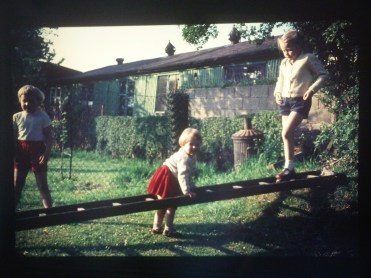
{Playing in the garden with my two older sisters – late 1960’s}
‘Home is the nicest word there is.’ – Laura Ingalls Wilder
The health of my Dad recently took a significant turn for the worse. He was admitted to a care home for some respite care and I think both he and the rest of us are wondering whether he will ever return home. Since I was 6000 miles away at the time, my thoughts turned very much toward home until I realised that ‘home’ has come a rather fluid concept in my life.
What is ‘home’ exactly? How can we define it? Perhaps we will all come to different conclusions, but it’s certainly a great deal more than mere bricks and mortar. My parents have lived in the same house for 55 years; I was born there, so does that qualify it for the status of ‘home’? Is home where we begin or where we end? Or is it, more probably, all those places in between that appear on our personal life map?
Since I left my family home I can count over 17 places where I have lived, and the strange nomadic existence I enjoy now only truly becomes ‘home’ when it contains the people I love. If they are there then even an airport lounge, or the immediate space around the computer on a skype call, can be home. Truth to tell, I think ‘home’ has far more to do with people than geography. It’s the cure for desolating loneliness, the antidote to the strain of trying to live up to oppressive expectations, and the elixir of life and laughter that revives all spectrums of disappointment and despair.
I believe that ‘home’ is made up of a kaleidoscope of ingredients: shared memory; family stories – some of which may be about members we have never met: quirky great-aunts, second cousins and grandmothers; nurtured culture; traditions and rituals – especially around landmarks like birthdays or Christmas; unrestrained and uninhibited laughter; a community where we can be who we are – warts and all – and still be completely accepted while our created uniqueness is celebrated; it is safety, comfort and the familiarity we find in a word, a touch, a phrase, a joke, a snatch of loved music, a personalised saying, a book or film quote, or in a family heirloom.
The thought that my initial address may soon be occupied by strangers with no knowledge of the thousands of memories that tie me to that place, saddens me. I pity them. Sure, they will make their own memories, but they will never know the delight and security I grew up with because they will never know the same people who came and went, shaping me, teaching me, loving me, challenging me and yes, even chastising me. I am very much a product of all the people in my family and extended family who nurtured me there from birth to young adulthood. Perhaps this is the real hold that ‘home’ has over us and explains the lifelong yearning to return that treasured space.
Many species return to their various ‘homes’ within their life cycle; some travel thousands of miles with the astonishing imprinted instinct of return somehow seared into their brains. It’s remarkable to discover that turtles return, many years later, to the beach where they were hatched to lay their own eggs. But don’t we all spend most of our lives trying to get back ‘home’ somehow? When you think about it, this is the theme of so much of our literature from Homer’s ‘Odyssey’, to John Bunyan’s ‘Pilgrim’s Progress’ and Tolkien’s ‘The Lord of the Rings’; all the characters are negotiating epic journeys to ultimately find their way back home.
Perhaps we have tried to re-create something of ‘home’ by honouring the same values in our adult families once our boundaries have extended beyond the original homestead. This is fraught with difficulty since, if you are a one half of a couple, you now have two sets of precious memory and rich heritage to fuse, animate and accommodate within your new combined culture. I’ve been back to my family house many, many times but I still recognise a desire to return, not to a rose-tinted yesteryear, but to that circle of unbreakable love.
And what if ‘home’ does not strike the same welcoming chord with you? If home only conjures up memories of conflict, tension, uncertainty, relational pain, fragmentation or worse? Somewhere in your conscious or sub-conscious self you will probably find the flicker of belief that a safe and welcoming ‘home’ can be found somehow, somewhere. Perhaps that conviction has already driven you onward through uncomfortable chaos to today.
For all of us, and more immediately, my Dad, the long road home is running out. Statistics tell us that we all die. No one is going to make it out of here alive. I believe there is another home that he is now heading towards which will be more and better than anything any of us have known so far. A place where he will be more himself than a failing body and weary spirit has ever allowed him to be here. A place where he will be welcomed and celebrated by many old friends and family, but better yet, by the One who has made the reunion possible. Home at last; what a homecoming that will be!
 dancingthroughchaos
This is wonderful Jenny x
LikeLiked by 1 person
Hi Judith; it’s amazing how we all have our unique ‘take’ on what or who ‘home’ is isn’t it?
LikeLike
What a great article – such a good topic especially for this season! I really enjoyed this, heart-warming and thought provoking, something that touches everybody! Brilliant!
LikeLiked by 1 person
Thanks Louise. This one has provoked some interesting responses with several people enjoying their own trip down personal memory lanes…
LikeLike
I think I have the t-shirt for this one… (I probably ticked off 17 places of residence in my first year in Andover?)
Your article mentioned safety once, but for the most part it seemed to conclude that ‘home’ is about good relationships first and foremost. While I agree that this is a prerequisite for a true home, I don’t think material security can be left out of the picture. Refugees might be surrounded by wonderful, caring friends and family. But they don’t feel at home. Uncertainty and threat to your continued existence and your access to basic needs like food and shelter ruin ‘home’. There is a moral stress within Christianity to disregard material needs (and I think it can make people uncomfortable with acknowledging this) but there is a reason that shelter is deemed a basic human right 🙂 It is hard to imagine what the homeless go through, but I assume that they each must find physical places that they go to regularly in order to retain some kind of continuity. Looking back on the last 11 years, for me geography is important as well as my residence. Cities or towns that I am very familiar with are ‘home’. Not just because of the positive associations of the good times I’ve had there, but also because of the security and control that knowledge gives you. If you know a place well then it is less threatening and you are less vulnerable to risk. On an unconscious level, that is also important.
LikeLiked by 1 person
Yes, Richenda, you’ve raised some good additonal points. I wrote this from my own nomadic situation in which we have no permanent bricks and mortar home, which swings alternatelybetween feeling rather wobbly and very liberating…
LikeLike