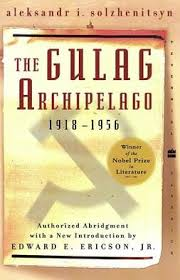
‘And he who is not sufficiently courageous to defend his soul — don’t let him be proud of his ‘progressive’ views, and don’t let him boast that he is an academician or a people’s artist, a distinguished figure or a general. Let him say to himself: I am a part of the herd and a coward. It’s all the same to me as long as I’m fed and kept warm.’ ― Alexander Solzhenitsyn, (The Gulag Archipelago 1918–1956)
I came across this fascinating quote recently, just as I was pondering on the strange but increasingly popular use of the word, ‘progressive’.
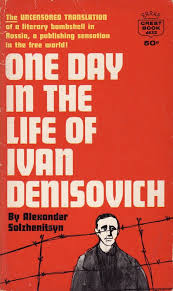
Solzhenitsyn wrote his three volume work over a ten year period depicting life in the Gulag (forced labour camps) which were a hideous institution created by Lenin and exacerbated by Stalin. I read his earlier work, One Day in the Life of Ivan Denisovich (published: 1963) when I was a student. A sobering work, it heightened my awareness of the plight of prisoners in Russia, China and North Korea, who were held against their will on account of their religious convictions. Those systems still exist and we’re now more aware of them than ever in places like Iran where Evin prison in Tehran is still considered by international observers as well as human rights organisations as one of the most notoriously brutal.
For years we’ve been fed the expectation – as were our parents and grandparents before us – that life would inevitably get better with each passing year. We would, without exception, be seeing improvements in every area of life. In primary school we contemplated what life in the year 2000 would be like. Wrapping our heads around the concept was challenging for a group of nine and ten year olds who could barely see beyond the last bell of the day, let alone thirty years down the road. Black and white text books indicated that we would all be wearing lycra, enjoying transport in streamlined vehicles that hovered above surprisingly quiet roads and eating some sort of hydrated but super-nutritional food – think of the world of 2015 that Marty McFly fell into in Back to the Future 2 and you’re about there.
Time and tension only go to show how wrong we were, but was but it wasn’t all fiction.
Life expectancy has risen, our understanding of how our minds and bodies work has made leaps forward and propelled our health in an upward trajectory; more people on the planet have access to clean water, education, the vote, dentistry, medical aid and the internet than ever before.
Why then, does so much of what purports to be ‘progressive’ really feel ‘regressive’?

Like me, do you hanker for those childhood days when good and evil presented themselves as black and white? We could, without hesitation, identify and separate the goodies from the baddies and easily differentiate between right and wrong.
Solzhenitsyn apparently contemplated the same sort of thing 60–70 years ago: ‘If only it were all so simple! If only there were evil people somewhere insidiously committing evil deeds, and it were necessary only to separate them from the rest of us and destroy them.‘
He dismissed Shakespeare’s villains Macbeth and Iago, believing the former to be full of excuses and the latter ‘a lamb’, though I’m not sure my English teacher would have agreed. He was convinced that the source of much of the evil came from ideology: ‘that is what gives evildoing its long-sought justification and gives the evildoer the necessary steadfastness and determination.’
I think we’ve been duped. While I appreciate that moral and ethical debates are more complex and more nuanced that my primary school self could ever have realised, the lines have now become so blurred and the arguments so tangled up in Orwell’s double-speak and group think that these days it’s all we can do to stop our heads exploding.

The focus of the western world is no longer on the job of putting food on the table or earning enough to ensure our children have at least a primary education. It doesn’t even seem all that interested in world peace any more. It’s become tied up in selfish ambition, identity politics, exploitation and abuse, tyrannical regimes masquerading as democracies in which the highest earners appear to operate by a different set of rules from the rest of us. Arresting Andrew Mountbatten-Windsor isn’t going to solve that. The Epstein files have opened an avalanche of horrifying depravity we cannot seem to stem.
Surely, none of this can be called ‘progressive’.

Perhaps Solzhenitsyn was ahead of his time when he wrote: ‘But the line dividing good and evil cuts through the heart of every human being. And who is willing to destroy a piece of his own heart?’
The diagnosis hasn’t changed: the heart of the problem is, and always has been, the human heart. And that, right there, is why we need a Saviour – not to magically solve every problem and put everything right, but to save us from ourselves and to walk through the mess with us.
Thank God we have one.
All quotes from Solzhenitsyn’s The Gulag Archipelago 1918–1956 Images (except book covers): Pixbay
 dancingthroughchaos
Thanks Jen
M xx
>
LikeLike
You’re welcome!
LikeLike