
‘…if the band you’re in starts playing different tunes I’ll see you on the dark side of the moon.’ Pink Floyd (Dark Side of the Moon 1973)
Over the years, we’ve taken countless couples through marriage preparation, and many others through counselling. One of the tools we’ve used is one we call, ‘Dark side/light side of the moon.’ (I’ll insert the diagram which illustrates the point further down the page.)
The moon is simply a metaphor for an issue or circumstance which, inevitably, we all see slightly differently. We come with our inbuilt biases, our lived experience, our learning styles, our personal cocktail of nature and nurture. Our point of view may also be reflective of our gender, our learning styles, thinking patterns etc and will therefore be expressed in multiple ways.
In many situations this just adds a bit of spice to life; some colour and nuance that reminds us that we are all created uniquely (thank goodness), and that people are endlessly fascinating. If they weren’t, life would be pretty stultifying and the creative world would grind to a halt fairly abruptly.

One person sees one side of the moon – the situation/issue – while another sees something quite different. One person prefers green, another claims that red is the best colour. Ideas of right or wrong are irrelevant in this example. Individuals can argue until they’re blue in the face (don’t you love a pun?) to advocate for their personal preference, but that’s all that it is. In the grand scheme, it doesn’t matter and maybe yellow is better after all.
In other areas of life, where values, beliefs and opinions jostle for position, each affecting our moral and/or ethical outlook and life choices, disagreements are played out on a larger, more impactful and more crucial scale. Conflict is inevitable; how we handle it, is not.
Continuing the marriage example, I can tell you that I am prone to see the cons rather than pros of any situation. I can focus on the cracks in an idea, the flaws in outworking that idea, the overlooked details and the pitfalls of pursuing a certain course of action. I am also aware that I am a linear thinker, take time to process persuasive arguments and am naturally more pessimistic than my husband. He is wired to see the bigger picture, thinks strategically, processes ideas quickly, can think on his feet, and so tends to filter out some of those details that scream for attention at me.
These opposing points of view are ripe for initiating conflict. Each of us looks at our own ‘side of the moon’. At this point, both of us could still see the idea/circumstance that’s presented and simply become even more convinced by what we see in front of us. Our next step is almost certainly to repeat ourselves, usually more loudly as we become more entrenched in our opinion. Clearly, we say to ourselves, he/she isn’t hearing me; I must explain myself again, better, more forcibly, in enhanced detail, and at greater volume.
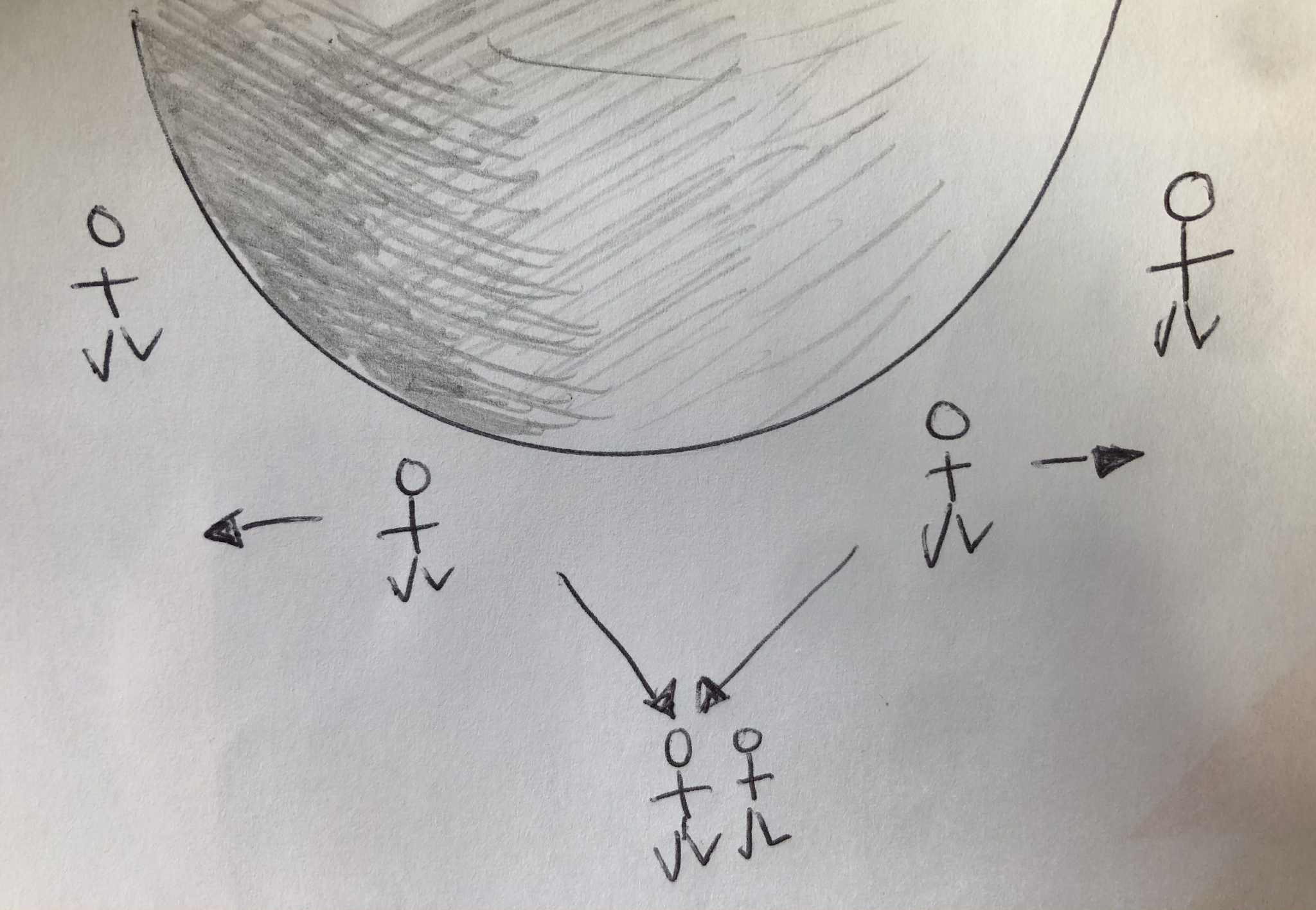
The usual consequence is that instead of bringing clarity and harmony to an issue, relationally we move further away from one another, both convinced that what we see is reality and now more entrenched in our position.
This is sometimes what happened in the early days of our marriage. Now, almost thirty-eight years in, we’ve learned a couple of things. One of the crucial pieces of wisdom we’ve picked up is that when such a situation arises, we need to stop, take a breath, step back from emotion and move position in order to try and see what the other is seeing. This requires oodles of patience (never my strongest point) and the willingness to listen rather than be heard, to lay aside frustration and refocus for the sake of the other one. This results in us moving closer to each other relationally (and sometimes, physically too) and in keeping unbridled and destructive anger at arms length.
One glance at social media or news reports demonstrates how this plays out on a larger scale. Too often convictions that lead to disagreements slide down that ugly slope of inflammatory language and words best left unsaid. Accusations about some kind of phobia fly around when it may well be that you just don’t agree with the opposing view which is held tightly for all sorts of reasons.
By seeing the apparently ‘opposite’, or at least, ‘different’ point of view, we may often find that we’ve missed something; we discover an element that was formerly out of our eye line, beyond the focused part of the picture that we had convinced ourselves was the whole picture. In a marriage context, my husband moves closer to my ‘dark side’ to try and appreciate what I’m seeing, while I make a choice to shift perspective and try to see what he sees.
Our conclusion may be that one us is more ‘right’ than the other, that we’ve both completely missed the actuality of any given issue or, more frequently, that two things can be true at the same time. Alternatively, we might continue to disagree and, guess what? That’s OK because we have chosen to stay in our covenant relationship through thick and thin: richer and poorer, in sickness and in health. Just because we don’t agree about everything doesn’t mean we can either yell ourselves into delirium or roll over to live in cowed subjugation or a permanent sulk. Love doesn’t live in those places.

What we can do is appreciate a different point of view, return to reasoned debate when required and even laugh at our foibles, without falling into violence.
Perhaps that sounds too simplistic and undoubtedly, there are some issues may be deal-breakers for any partnership, which is one of many reasons why prioritising talking to people, especially those closest to us, is so important. I have friends on all sides of the political spectrum but I don’t share a house with them all.
In our chaotic, dysfunctional, noisy world, we seem to be pitted against one another in increasingly distressing ways. Objective realities aside, debate, discussion and reason are becoming harder to find; formerly safe places are no longer the sanctuaries that we thought. The press carry emotive stories that cut and paste at will; social media drip-feeds inflammatory sound bites alongside virtue-signalling comments, while every person and their dog appear to feel obliged throw their hat in the ring with an opinion which they feel equally compelled (quite unnecessarily) to share on public forums. We haven’t been so divided for years.
CS Lewis, in his brilliant The Screwtape Letters, wrote with great insight about how the dark forces of spirituality might work their will to bring about the destruction of humanity. The premise of the book is that an old devil is mentoring his apprentice nephew through a series of letters, encouraging him to learn the best way to cause destruction in the world, particularly among people of faith, referred to as ‘the patient’.
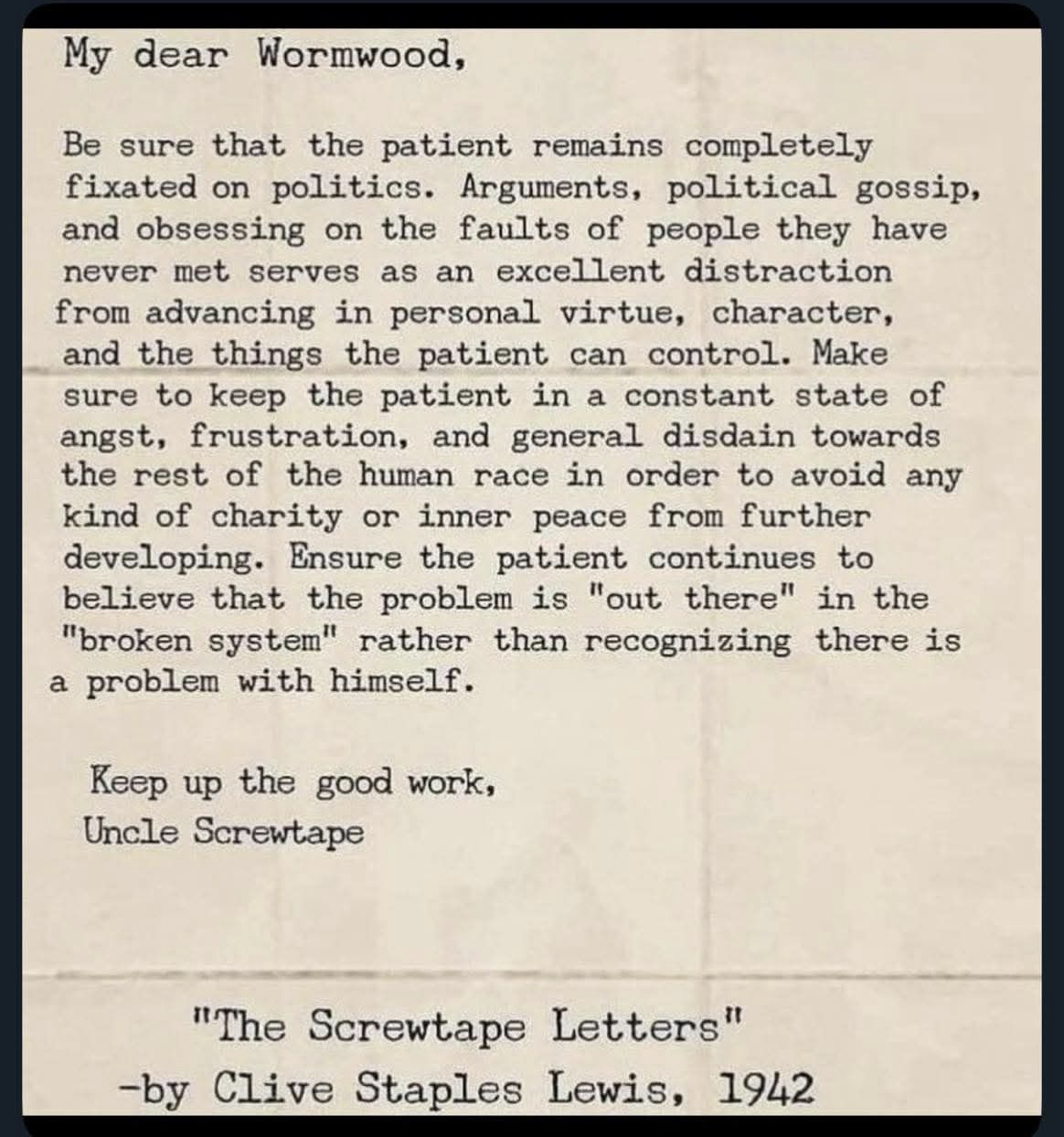
More than eighty years later, there’s a chilling reality to his words.
Whether we’re arguing about our favourite colour or any of the far more emotive moral/ethical dilemmas which face us each day, it might be good to be on our guard, resist the urge to fall into the ‘them and us’ trap, and remember the words of wiser counsellors.
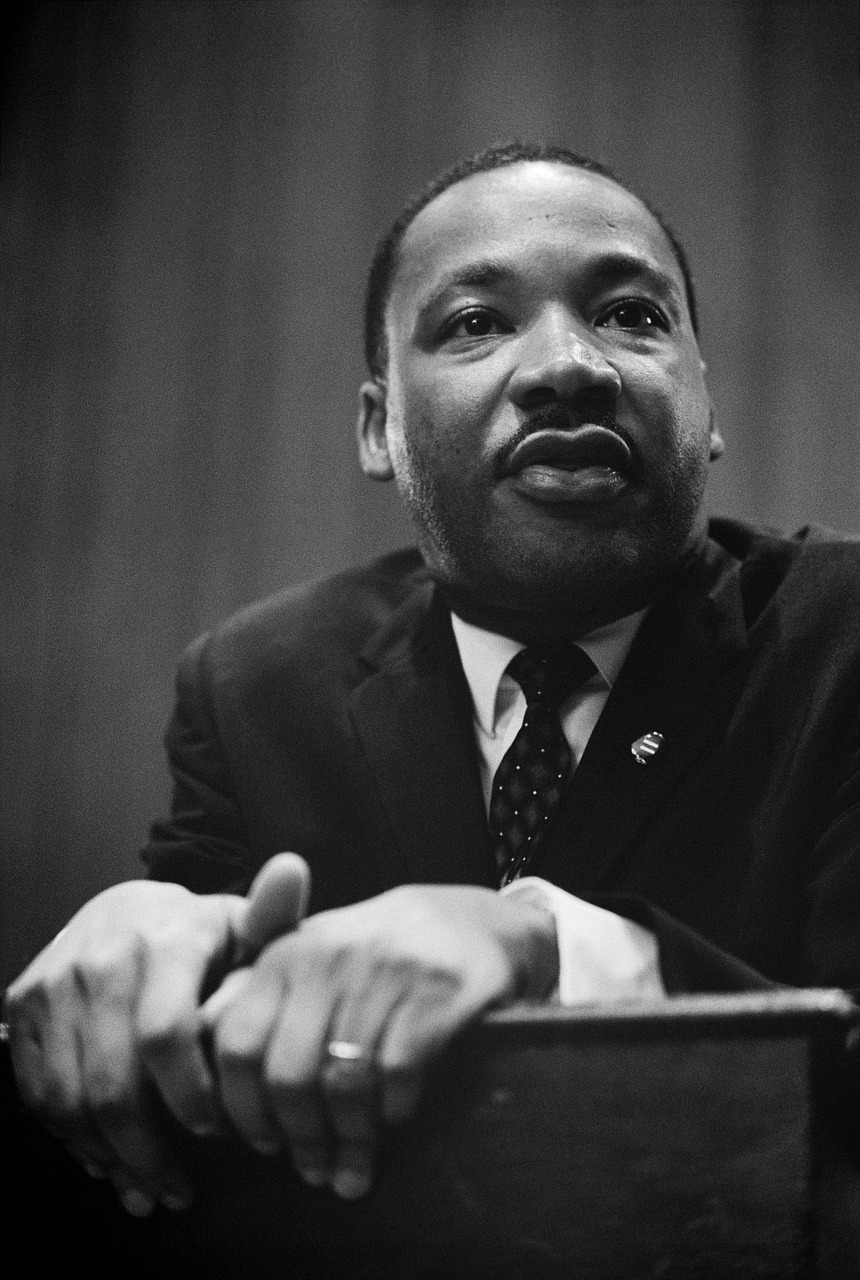
Martin Luther King declared that his ‘active non-violent resistance’ to evil: Does not seek to defeat or humiliate the opponent, but to win his friendship and understanding… The end is redemption and reconciliation. The aftermath of nonviolence is the creation of the beloved community, while the aftermath of violence is tragic bitterness.
His conclusion disagrees with Lewis’ essay entitled, Why I’m not a Pacifist, but there is merit in both men’s words. We could apply the above to any number of stories that have been thrust upon us over the last week or more, but let’s guard against both over simplification and overwhelming despair.
[Images: Michael Kleinsasser, Myléne, Ryan McGuire, WikiImages, all from Pixabay]
 dancingthroughchaos