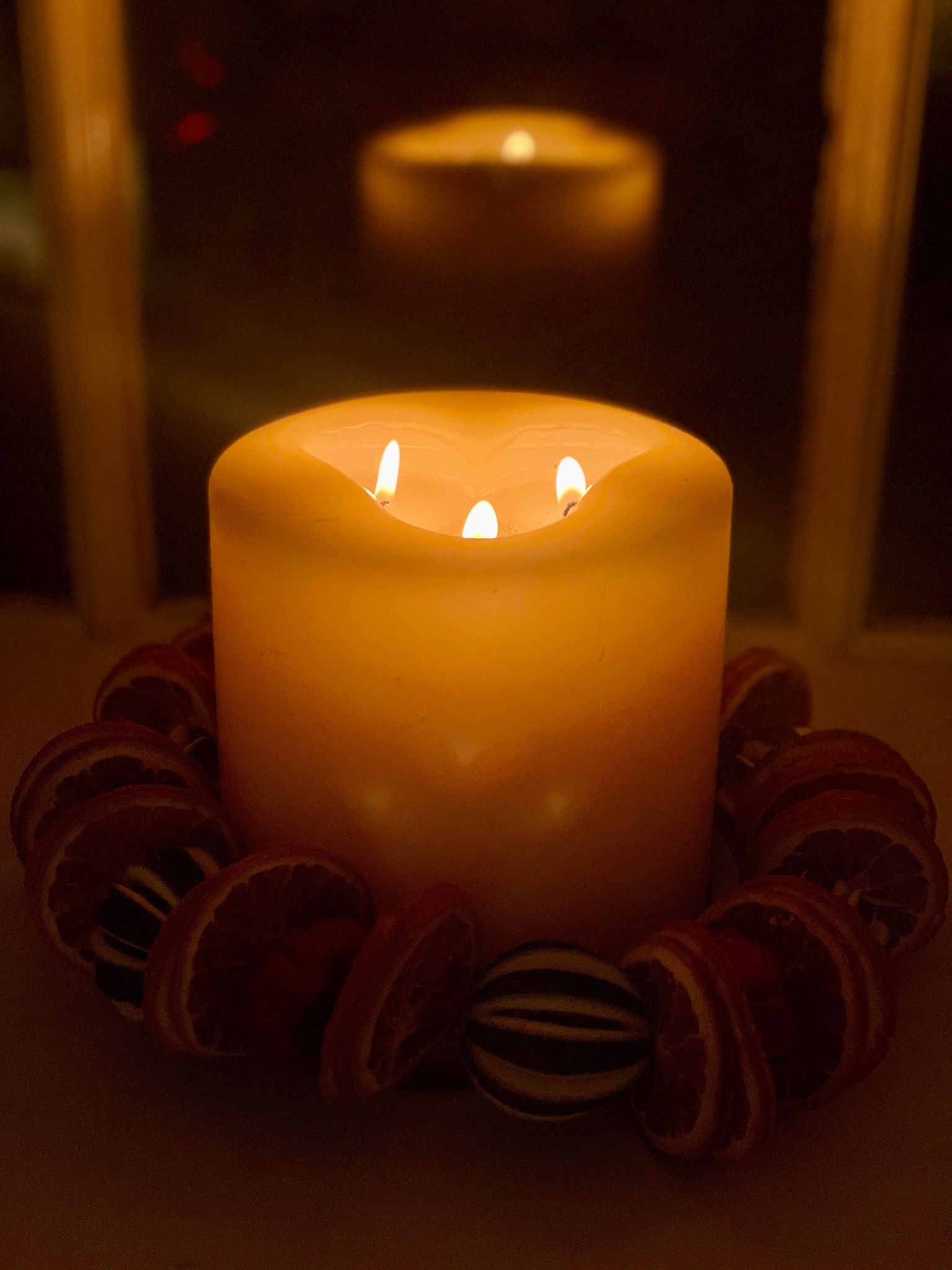
‘The light shines in the darkness, and the darkness has not overcome it.’ John 1:5
It’s been a long year.
I know that, technically, we’ve had the usual 52 weeks, plus that extra day for a Leap year – as if we hadn’t had enough of 2020 with the standard 365 this year! And now the winter days stretch wearily ahead of us with lockdown, tiers (and tears), new tiers, restrictions, a semi-hijacked Christmas, and who knows what ahead of us. Most of us will be glad to say a firm ‘goodbye’ to 2020 and all of its grim nonsense. Personally, I won’t be sorry if I never, ever, hear the word ‘unprecedented’ again…
It’s been a challenging year for all of us in different ways, but there is still much to be grateful for. I confess, I’ve found it quite difficult to hear anguished tales of thwarted travel plans and pub visits against the more serious backdrop of political corruption, scandals and dissension across the world. While we sometimes haven’t known whether to laugh or cry at the antics both across the pond and here at home, I’ve wept for our friends in Zimbabwe, where inflation soared to over 850% in July [https://tradingeconomics.com/zimbabwe/inflation-cpi#:~:text=Inflation%20Rate%20in%20Zimbabwe%20averaged,percent%20in%20December%20of%202009] and where truth is so heavily disguised it’s effectively buried; where journalists, politicians and activists have been abducted, tortured and broken – physically as well as emotionally – this year, for the crime of shining a light in unwelcome places and exposing malpractice, mismanagement and government looting [https://www.theguardian.com/world/2020/nov/03/zimbabwe-journalist-hopewell-chinono-arrested-again].
Our own sense of proportion has become somewhat parochial, and seriously warped, in an entitled society where we’ve been fed the lie for so long that life will, by definition, keep on getting better and better. As the west falls into free-fall decline, Europe is punishing the UK for voting to leave the union, while the east is rising in influence and reach, with a very different set of priorities, ethics and moral outlooks. The latest so called ‘catastrophe’ in the UK, according to the BBC news (10.12.20), seems to be that because various container ships aren’t where they should be, thanks to all the global shenanigans, there may now be a toy shortage [https://www.bbc.co.uk/news/topics/ckd0mgj43ddt/toys] this Christmas. As you may know, I’m a bit of a Christmas fanatic, but if our enjoyment rests on the presence (pun absolutely intended) or absence of a new gizmo which will most likely be broken before new year, then we are more pitiful than even I, in my most cynical moments, have sometimes thought.
Nevertheless, I do understand that we are all different, have a spectrum of thresholds for our own company, for a dearth of social interaction and all the other horrible paraphernalia that Covid has brought along with it. For those who have lost jobs, loved ones, special day celebrations and/or anniversaries, there is an inevitable knock-on of disappointment which, left untended, could fester into resentment, bitterness, self-reproach and gloom. On the up-side, I can’t remember a time when people were so aware of their mental health or, on the down-side, more prone to depression. That awareness is a good thing; the question is, what will we do about it?
In all honesty, the prospect for 2021 doesn’t currently look a lot brighter than 2020. Some people are pinning their hopes for ‘getting back to normal’ (heaven help us) on the vaccines now being rolled out around the country. Others anticipate the fall out of its, as yet, unknown long-term side-effects. There’s so much fake news swirling around the social media vortex it’s not that easy to get to the truth. The prophets of doom warn us that food prices will rise as tariffs change with Brexit; we’re told that shortages are inevitable and that unemployment may be the worst it’s been since the 1980s [https://www.peoplemanagement.co.uk/news/articles/uk-unemployment-rate-worse-official-figures-suggest-academics-warn] or even The Great Depression [https://www.theguardian.com/world/2020/apr/03/coronavirus-uk-business-activity-plunges-to-lowest-ebb-since-records-began] (depending which newspaper you read). The Financial Times tells us to brace ourselves for the worst recession since the 1700s [https://www.ft.com/content/734e604b-93d9-43a6-a6ec-19e8b22dad3c]; Unicef is to start a domestic food programme for UK children [https://www.bbc.co.uk/news/uk-england-devon-55348047]; we have have a generation of pupils floundering to reach standard targets having missed so much of their school year, and the poor old NHS is, according to a report from The King’s Fund in October this year, at breaking point yet with thousands of unfilled vacancies [https://www.kingsfund.org.uk/projects/positions/nhs-workforce]. No amount of well-intentioned applause is going to fix that. In fact, there seems to be no end to the bad news that faces us each morning as we rise or every evening as we stagger, mentally exhausted, off to bed. It’s relentless, interminable and brutal.
All in all, 2021 looks pretty dark and dismal from here, which is why the hope and light of Christmas is more than usually appealing this year.
In past years I have scurried around the city of Bath like a carol service junkie (I think four in one day was a personal record). This year, of course, they are on-line which gives me the added advantage of staying in the warm and, should I wish, my PJs. I love the familiar words and melodies that were the backdrop to all my childhood Christmases and which have stayed with me for well-over half a century.
My most loved carol is, as my friends well know, In The Bleak Mid-Winter, because, while I know it’s unlikely that ‘snow [has ever] fallen snow on snow’ in Bethlehem, the last verse gets me every time as it considers what might be a suitable thank offering to bring to the Christ child. My favourite of the traditional nine ‘lessons’ is the final one from John 1 which begins: ‘In the beginning was the Word, and the Word was with God, and the Word was God’ and goes on to include the quote above. It’s beautiful as literature, but powerful as a living truth of who Jesus is and was. The Christ of Christmas (the clue’s in the question, as they say) is often forgotten, buried or disregarded, but John reminds us that Jesus is no longer just a baby in a manger. He tells us who He is and why He came. Jesus is The Light, not just for one Bethlehem night, but for the whole world while time and history exist.
That light still shines. There is no darkness on earth or under the earth which can quell this particular illumination. Christmas can never be cancelled.
Light gives us hope, a focus, a destination and a means of navigating, if not the whole path, then at least the next step. Let’s keep inching our way towards that Light – the knowable, accessible person of Jesus – this Christmas, knowing that He has 2021 safely in His hands. Let’s avail ourselves of His promise to walk through it beside us whatever it brings.
There is a tradition which requires every electric light in church to be snuffed out leaving one small candle flickering while the John 1 passage is read. It’s a powerful illustration of how even the tiniest, weakest, feeblest flame can dispel the blackest darkness.
When His light lives in us then we can bring that light, His Light – even if it flickers at times – faith and hope to the bleakest situation. Be assured: the thickest darkness has never yet overcome that light in 2,000 years, and it never will.
Happy Christmas!
 dancingthroughchaos
Thanks Jenny for this timely Word in Season. Love A&G x
LikeLiked by 1 person